Dress Like You Mean It: Navigating Bold Style in a World That Prefers You Quiet

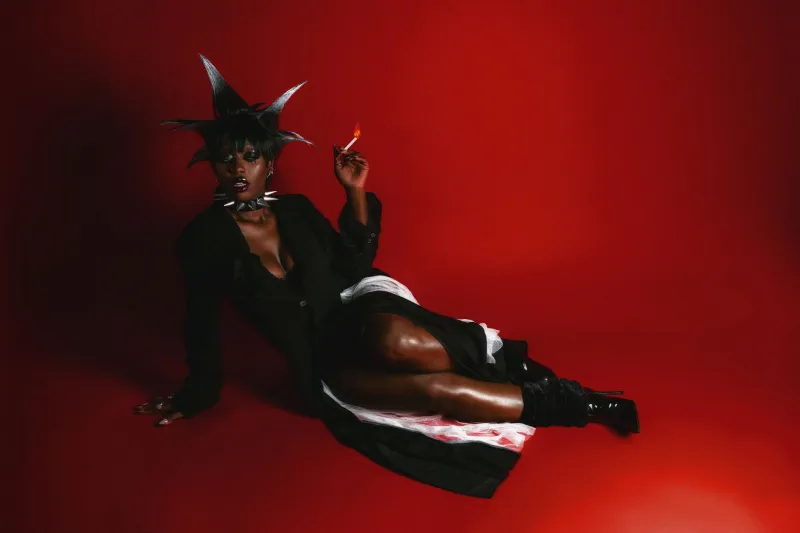
Photo: confident woman bold colorful fashion professional setting power dressing editorial, via i.pinimg.com
Let me tell you about a specific kind of morning.
You get dressed in something that genuinely excites you — a structured blazer in a color that makes you feel like you could run a small country, or a skirt with a silhouette so deliberate it practically has its own opinions. You look in the mirror and something clicks. This is it. This is exactly right. And then, somewhere between the mirror and the door, a quieter voice starts negotiating. Is this too much for a Tuesday? Will my coworkers think I'm trying too hard? Will my boss take me less seriously? Will strangers on the subway stare?
And sometimes — more often than anyone likes to admit — you change.
That negotiation, that specific internal friction between the version of yourself you want to present and the version you calculate will be most socially acceptable, is one of the most underexamined forms of pressure women navigate daily. It happens in boardrooms and brunch spots and grocery store parking lots. It happens across age groups, industries, body types, and zip codes. And it is, at its core, a conversation about power — who gets to take up visual space, and on whose terms.
The Shrinking Expectation
The instruction to shrink isn't always explicit. It rarely comes as a direct command. More often it arrives as a comment — you look so put together today said with a slight emphasis that implies most days you're too much. Or as a question — are you going somewhere special? asked when you're wearing something that's simply, unapologetically intentional. Or as silence: the moment when you walk into a room and the air shifts in a way that makes you suddenly aware of your own presence.
These are the micro-signals through which culture communicates its preferences. And they add up.
For women in professional spaces particularly, the math around dressing boldly gets complicated fast. Research consistently shows that women face a narrower band of acceptable self-presentation than men do — too casual and you're not taken seriously, too polished and you're seen as vain or trying too hard, too colorful and you're a distraction, too fashion-forward and you're frivolous. The acceptable range is narrow and its edges are enforced socially, not officially, which makes them both harder to challenge and easier to internalize.
The result is a kind of aesthetic self-censorship that's so normalized most women don't even notice they're doing it.
The Confidence Paradox
Here's the part that makes this genuinely complicated: the same culture that penalizes visible boldness also rewards confidence. We are simultaneously told to shrink and told to own our power. To not call attention to ourselves and to command the room. To be likable and to be a leader. These instructions are not compatible, and the contradiction sits squarely in the closet every morning.
What gets called "the confidence paradox" in fashion is this: the women who dress most boldly and authentically are often perceived as the most confident, but the act of dressing that way requires confidence that's difficult to sustain against constant social friction. You have to be bold enough to dress boldly before dressing boldly makes you feel bold. The chicken-and-egg quality of it is real, and it's exhausting.
But here's what's also true: the women who push through that friction — who wear the color, who commit to the silhouette, who walk out the door in the thing that makes them feel most like themselves — tend to report something that sounds almost like a physical shift. A posture change. A different quality of presence. The clothes aren't creating the confidence from scratch, but they're making it easier to access what was already there.
What "Too Much" Is Actually Telling You
When someone tells you — directly or through implication — that your style choices are too much, it's worth pausing on what that phrase is actually doing.
"Too much" is a measurement. It requires a baseline. Too much compared to what, exactly? Too much compared to the amount of visual space a woman is expected to occupy in that particular context. Too much compared to the implicit agreement that women's appearance should be pleasant and undemanding and easy to look at without requiring any real engagement.
Rejecting "too much" as a meaningful critique isn't about being contrarian or performatively rebellious. It's about recognizing that the baseline itself is arbitrary and politically loaded — and that you are not obligated to organize your self-expression around someone else's comfort with your visibility.
This is a genuinely progressive position, and it's one that fashion, at its most intentional, has always made space for.
Practical Strategies for Holding Your Ground
None of this means the friction disappears. But there are ways to navigate it without constantly compromising.
Know your why. When you have a clear sense of what your style choices mean to you — what they communicate about your values, your identity, your relationship to your own body and presence — they become harder to negotiate away in a moment of social anxiety. Style with intention is more resilient than style based on what feels safe.
Build a community of mirrors. Find the people in your life — friends, colleagues, online communities — who reflect your boldest self back at you with enthusiasm rather than alarm. The social feedback loop matters. Surround yourself with people who celebrate your visual courage rather than politely tolerating it.
Separate professional strategy from self-suppression. There's a real difference between understanding the context you're operating in and flattening yourself to disappear within it. You can read a room without erasing yourself in it. A bold earring in a conservative meeting room is not a political miscalculation — it's a data point about who you are.
Wear the thing enough times that it stops being a decision. A lot of the discomfort around bold dressing comes from novelty — yours and other people's. The more consistently you show up in a strong personal aesthetic, the more it becomes simply how you dress rather than a statement requiring constant justification.
Stop apologizing for taking up space. This one is harder than it sounds and more important than almost anything else on this list.
The Radical Act of Dressing for Yourself
At Pink Dragon Studio, we talk a lot about bold, fearless femininity — not as a performance for an audience, but as a practice of self-recognition. The most radical thing about dressing for yourself, truly for yourself, is that it removes the external audience from the equation. You're not dressing to be perceived as confident. You're dressing because this is who you are, and clothing is one of the languages you use to say it.
That shift — from dressing for reception to dressing for expression — doesn't happen overnight. It's a practice, like anything else worth doing. It requires you to notice the moments when you're negotiating yourself smaller and to ask, honestly, whether the negotiation is worth it.
Sometimes it is. Context is real, stakes are real, and choosing your battles is a legitimate form of intelligence. But more often than most women realize, the negotiation is happening on autopilot — a habitual self-editing that's become so second nature it doesn't even feel like a choice anymore.
The goal isn't to wear something outrageous every day. The goal is to make the choice consciously. To put on what makes you feel most like yourself and walk out the door without the negotiation. To let the boldness be unremarkable — not because the world has become more accommodating, but because you've stopped requiring its accommodation.
Dress like you mean it. All of it. Every time.