Dead Stock, Living Proof: How Vintage Fashion Became Gen Z's Most Radical Act
Something happened to thrifting. It used to be a practical thing — you went to the Goodwill because money was tight, you found something that worked, you felt good about the deal. The aesthetics were secondary to the economics.
That is not what's happening now.
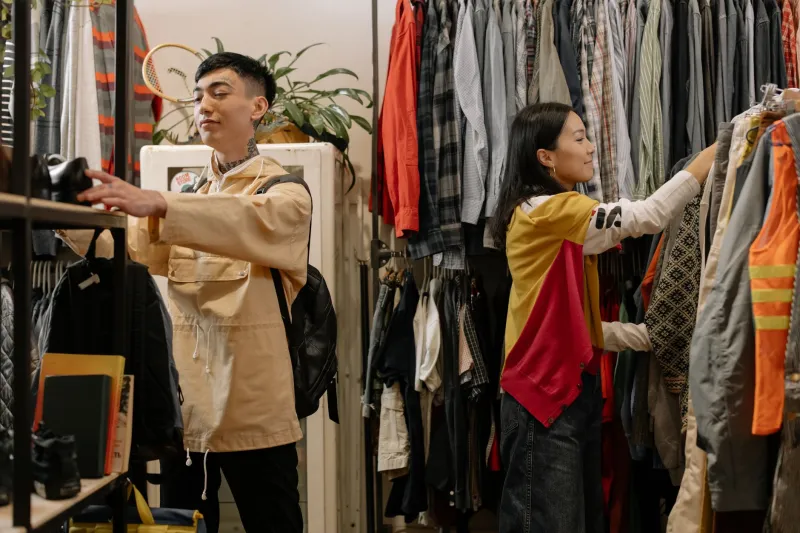
What's happening now is a 23-year-old in Columbus spending her Saturday morning elbow-deep in a Bins location, methodically working through racks with the focus of someone who has done her homework. She knows what deadstock denim from the late '70s feels like between her fingers. She knows which decade of Levi's has the best cut. She's not there because she can't afford new. She's there because buying new, to her, represents a set of values she has consciously decided to reject.
That is a completely different thing. And it's reshaping American fashion in ways the industry is only beginning to reckon with.
From Necessity to Ideology
The timeline of thrifting's cultural evolution is worth tracing, because it explains a lot about where we've landed.
For most of the 20th century, secondhand shopping in America carried a stigma. It was what you did when you had no other option. The post-WWII economic boom and the rise of mass retail made new clothes cheap and plentiful, and buying used was coded as poverty.
The '90s started to chip at that. Grunge aesthetics, the rise of vintage as a specific aesthetic category (not just secondhand), and the early stirrings of environmental consciousness made thrifting cooler but still niche. It was a subculture.
Then came the 2010s — fast fashion at full industrial scale, Instagram, and the algorithmic trend cycle that compressed fashion seasons from four to forty. The result was an industry producing an estimated 100 billion garments a year for a planet of 8 billion people. The environmental math became impossible to ignore.
For Gen Z, who grew up with climate anxiety as a background condition of their entire conscious lives, that math landed differently than it did for older generations. They didn't just feel bad about it in the abstract. They felt implicated. And they started looking for exits.
Authenticity as a Scarce Resource
Here's something the fashion industry underestimated: Gen Z doesn't just want sustainable clothes. They want clothes that feel real.
In an era of algorithmic trend generation — where microtrends are manufactured, distributed, and retired in weeks — the appeal of a 1982 Levi's trucker jacket isn't just environmental. It's existential. That jacket existed before the algorithm. It has a history that no marketing department invented. It can't be copied and mass-produced because there are only as many of them as there are.
Scarcity is back as a value, but it's not the artificial scarcity of a limited drop. It's the genuine scarcity of something that was made once, a long time ago, and is still here.
"I can walk into any Urban Outfitters and see the same fifteen things that every other Urban Outfitters in the country has," says Destiny, 26, a graphic designer in Austin who runs a vintage resale account with over 40,000 followers. "Or I can find something that nobody else has and that nobody can just go buy. That feels like having an actual identity instead of a purchased one."
This is vintage as authenticity infrastructure. And it's a direct response to the relentless corporate packaging of individuality.
The Sustainability Argument Gets More Complicated
Let's not pretend the sustainability math on vintage is entirely clean, because it isn't.
The rise of resale platforms like Depop, Poshmark, ThredUp, and The RealReal has created a secondary market so robust that it has its own speculative dynamics. Vintage items get flipped for significant markups. Rare pieces are gatekept by resellers who've turned thrifting into a profession. The Goodwill in a gentrifying neighborhood gets picked clean before community members who actually need affordable clothing can access it.
There's also the carbon footprint of shipping individual secondhand items across the country, which adds up in ways that bulk retail shipping doesn't.
But — and this is important — the comparative environmental math still favors secondhand overwhelmingly. The production of a single new cotton T-shirt requires approximately 700 gallons of water. A vintage T-shirt requires none. Even accounting for resale shipping, the lifecycle impact of secondhand clothing is a fraction of new production.
The ideology holds up, even when the practice gets messy.
Deadstock: The Purist's Choice
For a subset of vintage enthusiasts, thrifted secondhand isn't quite enough. They've moved to deadstock — new-old-stock items that were manufactured decades ago but never sold, sitting in warehouses or estate sales until someone finds them.
Deadstock is the most extreme version of the anti-production stance: you're wearing something that was already made, requires no new resources, and carries the design DNA of its original era without the wear of actual use. It's simultaneously vintage and new, which sounds like a contradiction until you hold a piece of deadstock '60s fabric in your hands and understand exactly why someone would pay a premium for it.
Small designers are building entire collections around deadstock sourcing — brands like Christy Dawn (which has made deadstock fabric its founding principle) and various independent labels operating out of LA's Arts District are treating historical fabric inventories as a design resource rather than a compromise.
What This Means for the Industry
The fashion industry is paying attention, and its response has been predictably clumsy. Major brands have launched "vintage" collections that are new garments artificially distressed. Retailers have created "curated thrift" sections that charge vintage prices for items sourced cheaply in bulk. The word "sustainable" has been applied to collections that are 5% recycled material.
Gen Z is not fooled. The same generation that grew up navigating algorithmic manipulation has developed a finely tuned detector for authenticity washing. They know the difference between a brand that has genuinely restructured its supply chain and one that launched a hemp tote bag and called it a values statement.
The brands that are earning trust in this space are the ones doing the unglamorous work: transparent supply chains, genuine deadstock sourcing, repair programs, and the willingness to tell customers to buy less rather than more.
Dressing Against the Current
At its heart, what vintage fashion represents for the women leading this shift is a refusal. A refusal to participate in a system that treats clothing as disposable, identity as purchasable, and the future as someone else's problem.
There's something deeply in line with the Pink Dragon Studio ethos in that stance — boldness doesn't always mean the loudest color or the most dramatic silhouette. Sometimes it means the quiet, deliberate choice to step sideways out of the machine entirely.
A woman in a perfectly sourced vintage blazer from 1979 isn't just wearing a jacket. She's making an argument about what fashion is for, who it serves, and what it means to build a personal aesthetic that belongs entirely to you.
That's not nostalgia. That's a blueprint.