Armor Up: The Psychology Behind Dressing Like You Already Won
There's a moment — you probably know it — where you zip something up, catch your reflection, and feel a shift. Not vanity. Something deeper. A kind of internal recalibration, like your nervous system just got the memo that today is not the day to mess with you.
That's not a coincidence. That's design doing exactly what it was always capable of doing.
At Pink Dragon Studio, we've always believed that fashion is a language. But lately, the conversation has gotten more intentional. Women aren't just dressing for occasions anymore — they're dressing for outcomes. And the psychology behind that shift is genuinely fascinating.
The Science Has a Name for It
Fashion psychologist Dr. Dawnn Karen, one of the first professionals to hold that specific title, has spent years documenting how clothing choices affect mood, behavior, and social perception. The concept she calls "mood illustration" — dressing to reflect or amplify an emotional state — has moved from academic theory into everyday practice for a growing number of women.
But there's a more aggressive version of this playing out right now: dressing not to reflect how you feel, but how you intend to feel. Pre-emptive armor. Aspirational silhouettes.
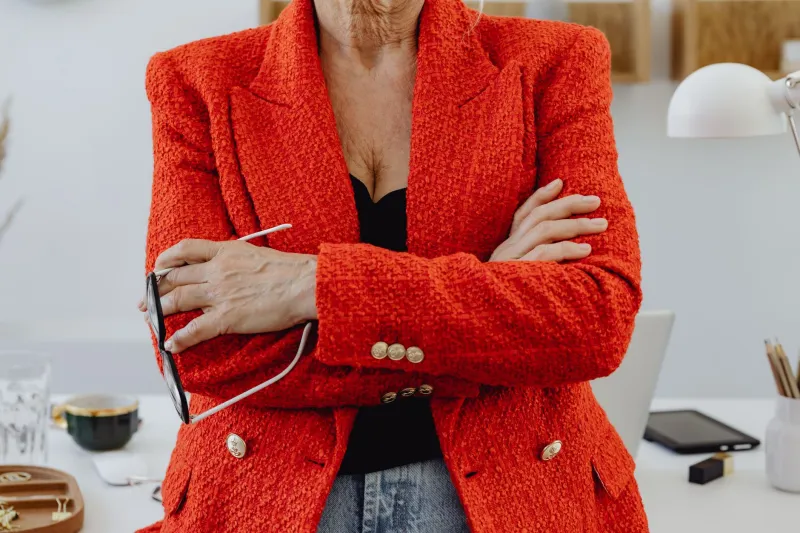
"I started wearing structured blazers to every pitch meeting even when I felt completely terrified inside," says Maya, a 34-year-old creative director based in Brooklyn who asked to use only her first name. "At some point I realized the blazer wasn't hiding my anxiety — it was actually dissolving it. I'd put it on and my posture would change. My voice would change. It became this ritual."
This isn't just anecdote. Research from Northwestern University on "enclothed cognition" — a term coined by Hajo Adam and Adam Galinsky — found that wearing clothing associated with certain traits literally activates those traits in the wearer. The clothes don't just signal to others. They signal to you.
Bold Silhouettes as Social Currency
Walk through any major US city right now and pay attention to the women taking up space. Not metaphorically — literally. Wide-leg trousers that sweep the sidewalk. Coats with shoulders that need their own ZIP code. Boots that announce arrivals three seconds before the person does.
This isn't maximalism for maximalism's sake. It's spatial claiming. Fashion designers from Thom Browne to Pyer Moss have been playing with volume and structure in womenswear specifically as a commentary on presence — on the cultural history of women being asked to shrink.
When a woman chooses an exaggerated silhouette, she's not just picking an aesthetic. She's opting into a visual argument about how much room she deserves.
"There's something deeply political about a woman in a dramatic coat just walking into a room," says Jasmine Elias, a wardrobe consultant who works with female executives in Chicago and New York. "Her clients have told me they get treated differently. People hold doors longer. They get interrupted less in meetings. The clothing is doing social work."
Texture as Psychological Warfare
Silhouette gets the headlines, but texture might be doing some of the heaviest lifting in the confidence equation. Think about the difference between wearing a limp polyester blouse and a heavy crepe shirt with real structure. The weight of quality fabric against your skin changes your posture before you even consciously notice it.
Boucle has had a cultural moment for exactly this reason. It's tactile, substantial, and visually complex — it rewards attention. Same with leather, which has moved far beyond its rebellious biker-jacket origins into everyday power dressing. When Bottega Veneta started putting women in buttery, unadorned leather everything, the message wasn't about toughness. It was about ease. Confidence so settled it didn't need to shout.
Statement textures also create what stylists call a "conversation redirect" — they give people something to engage with before they've assessed anything else about you. You control the first impression because you curated the first thing they see.
The Transformation Catalyst
Some of the most compelling stories in this space come from women who used deliberate style shifts as a catalyst during major life transitions. Not as a response to change, but as an initiator of it.
Tamara, 41, a healthcare administrator in Atlanta, describes a period after her divorce when she made a conscious decision to rebuild her wardrobe from scratch. "I gave away everything that felt like the person I was trying to keep him happy with. Beiges. Safe cuts. Things that took up as little space as possible. And I started buying things that felt like who I actually was — bold colors, interesting cuts, things that made me feel like I was walking into a room with something to say."
She's clear that the clothes didn't fix anything. But they functioned as a daily commitment — a physical, wearable reminder of the identity she was actively constructing. "Every morning I was making a choice. It sounds small but it added up."
This is the Dragonslayer dynamic in practice: not waiting until you feel powerful to dress powerfully, but using the act of dressing as the first move in a longer game.
Intention Is the Whole Point
What distinguishes this from just wearing nice clothes is the intentionality. The women doing this aren't shopping impulsively or chasing trends. They're building wardrobes with purpose — identifying what each piece does for them psychologically and editing ruthlessly for everything that doesn't serve that function.
It's a design practice, really. The same way Pink Dragon Studio thinks about bold aesthetics not as decoration but as communication, these women are treating their wardrobes as a creative brief: who do I need to be today, and what do I need to wear to get there?
The answer, increasingly, looks like structured shoulders, unexpected textures, and the specific kind of color that makes your nervous system stand at attention.
Suit up. The meeting already started.