Silk and Subversion: Why the Slip Dress Is the Most Political Thing in Your Closet
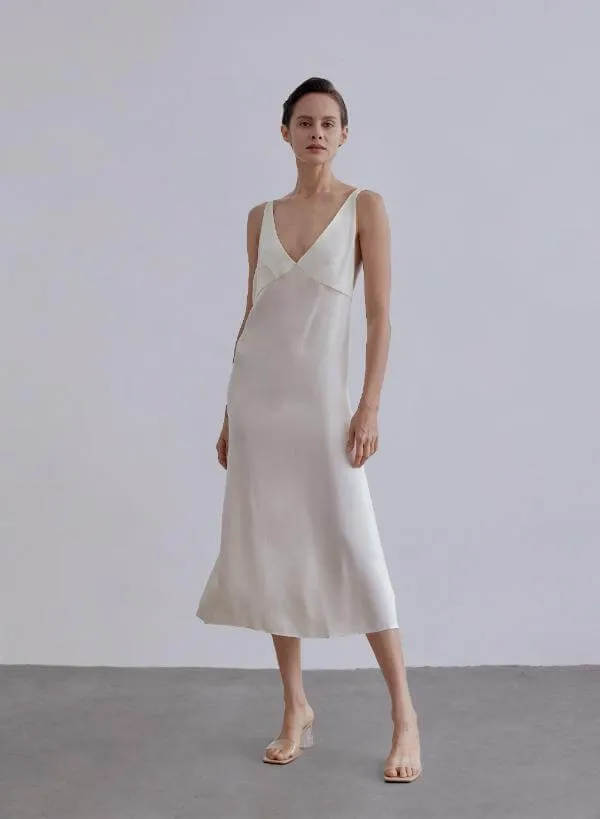
Photo: woman in silk slip dress confident professional setting editorial fashion, via www.fashionacy.com
There's something almost deceptive about the slip dress. It arrives in your closet looking humble — a little satin, a couple of bias-cut panels, maybe a lace trim that whispers rather than shouts. It doesn't have the obvious armor of a sharp blazer or the theatrical presence of a sculptural gown. And yet, somehow, women who wear it to meetings, gallery openings, and first dates are consistently told it's too much. Too revealing. Too intimate. Too close to underwear to be taken seriously.
Which is exactly why it's become one of the most radical things you can put on your body right now.
From the Bedroom to the Boulevard
The slip dress has always lived in a complicated neighborhood between private and public. Its origins are literally undergarment — a smooth underlayer worn beneath heavier dresses to prevent clinging and add comfort. For most of fashion history, it stayed there, hidden and functional, never meant to be seen.
Then the nineties happened. Kate Moss on a red carpet in a sheer bias-cut slip. Courtney Love weaponizing babydoll silk against the entire concept of rock-and-roll masculinity. Calvin Klein stripping everything back to a clean, spare column of fabric that felt more like a statement than a dress. Suddenly the slip dress wasn't hiding under anything — it was the thing. And the cultural discomfort that followed was, in retrospect, deeply telling.
We've been arguing about the slip dress ever since.
The Boardroom Is Not Ready
Ask any woman who has worn a slip dress to a professional setting and she'll have a story. Maybe it's the colleague who asked if she'd "forgotten" part of her outfit. Maybe it's the HR handbook that technically doesn't prohibit it but somehow makes it feel transgressive anyway. The corporate world has very specific ideas about what female professionalism looks like, and a dress that skims the body in liquid fabric is not generally part of that approved vocabulary.
But here's what's interesting: the women who wear slip dresses to work anyway — and there are more of them every year — aren't doing it carelessly. They're doing it deliberately. Styled over a fitted turtleneck, layered under an oversized blazer, or worn with serious block-heeled mules and a structured bag, the slip dress becomes a kind of visual argument. It says: I can hold authority and sensuality in the same body at the same time. These things are not in conflict. Your discomfort is not my problem.
That's not a fashion choice. That's a position.
Designers Who Are Leaning All the Way In
Contemporary designers have clearly gotten the memo. Brands like Khaite, Toteme, and Ludovic de Saint Sernin have each, in their own way, pushed the slip dress into new emotional and aesthetic territory. Khaite's version often carries a quiet tension — something that feels both vulnerable and controlled, like a sentence left deliberately unfinished. De Saint Sernin's take strips away all pretense of casualness and plants the garment firmly in the territory of intentional sensuality, refusing to apologize for it.
Independent American designers are doing equally interesting work. Emerging labels are experimenting with slip silhouettes in unexpected fabrics — heavy matte crepe that reads almost corporate, raw-edged silk that looks deliberately undone, even deconstructed denim versions that short-circuit the garment's usual associations entirely. The message in each case is the same: we're not trying to make this more acceptable. We're asking you to expand what acceptable means.
Real Women, Real Rooms
What's most compelling about the slip dress renaissance isn't what's happening on runways — it's what's happening in actual American cities, in actual women's real lives.
There's the Chicago-based art director who wears a champagne satin slip dress to client presentations because, as she puts it, "it makes me feel expensive and unbothered at the same time, and that's exactly the energy I want walking into a room." There's the Brooklyn gallerist who layers hers over a crisp white button-down and calls it her "I'm the one with the vision" uniform. There's the Austin-based tech founder who pairs a dark plum slip with serious boots and a blazer thrown over her arm — not on, just over her arm — and says the whole look is about showing up on her own terms.
None of these women are wearing slip dresses because they're trying to be provocative. They're wearing them because the garment, in its very simplicity, gives them something a lot of fashion doesn't: complete ownership of how they're perceived.
The Modesty Conversation Nobody Asked For
Let's be direct about something. The persistent discomfort around the slip dress is not really about fabric or formality. It's about the fact that it doesn't hide the body — and in a culture that has historically required women to either minimize or armor their physicality in professional and public spaces, a garment that simply reveals the shape of a person feels like a violation of an unwritten rule.
But that rule was never written for women's benefit. It was written to manage us.
Reclaiming sensuality as a form of authority — rather than a liability — is one of the genuinely radical moves available to women in fashion right now. The slip dress, in its refusal to be either more modest or more theatrical than it is, sits right at the center of that reclamation.
How to Wear It Like You Mean It
The slip dress rewards intention. Here's how to wear it so the statement lands the way you want it to:
Layer with purpose. A fitted ribbed turtleneck underneath shifts the whole energy from sensual to intellectual without losing the silhouette. Try it.
Let your shoes do the talking. Chunky loafers or serious ankle boots ground a slip dress firmly in "I meant to do this" territory. Avoid anything that reads too cocktail-adjacent if you're taking it somewhere professional.
Treat the bag like a counterweight. A structured leather tote or architectural shoulder bag next to the softness of a slip creates the kind of tension that reads as completely intentional.
Don't over-style. The slip dress is strong precisely because it's simple. Trust it. One interesting piece — a bold earring, a single stacked ring, a great belt — is enough.
The slip dress doesn't need you to dress it up into something more respectable. It needs you to show up in it like you already know you belong in the room.
Which, for the record, you do.