Beautiful Chaos: The Art of Mixing Styles That Were Never Supposed to Meet
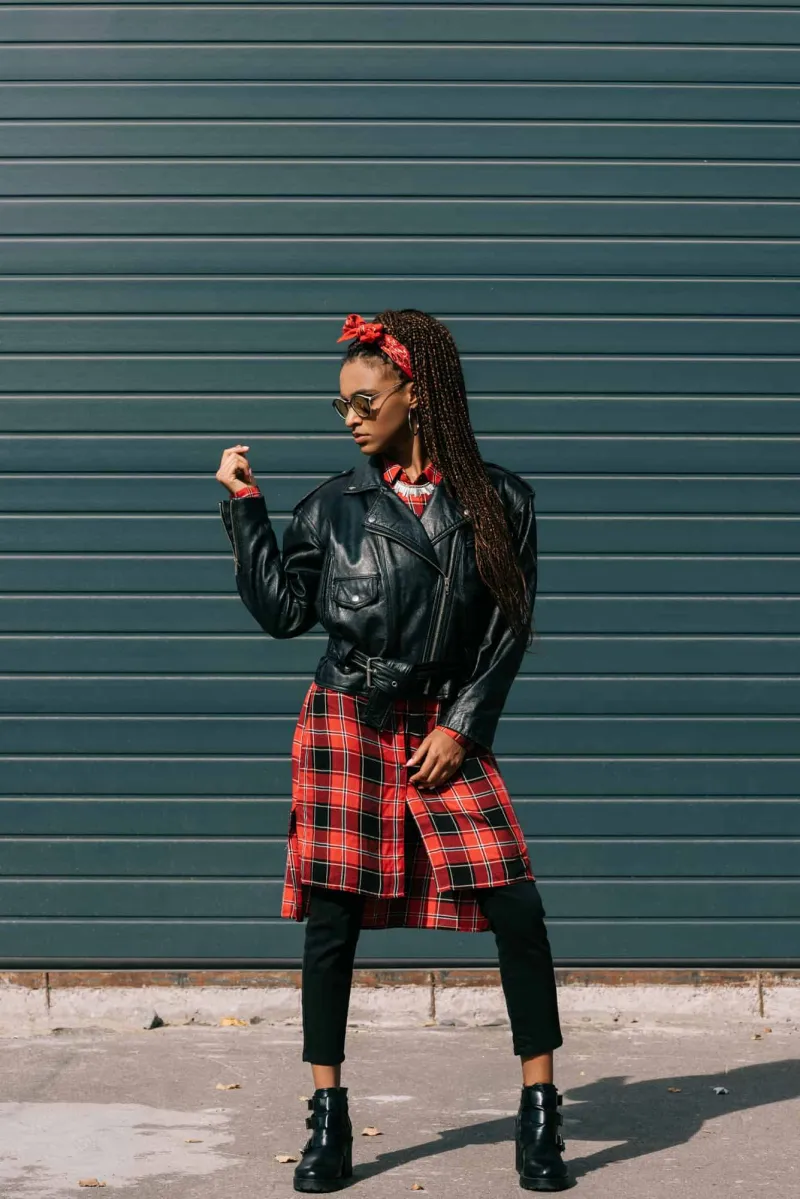
Photo: woman mixing contrasting fashion styles edgy feminine bold outfit street style, via savvysouthernchic.com
Let me tell you about a look I saw on the subway in New York last fall that I still think about. A woman, maybe thirty, in a perfectly fitted charcoal gray pencil skirt — the kind that reads as aggressively corporate — paired with a shredded band tee, a pearl choker, and enormous platform boots that looked like they'd walked off a Demna runway. Her bag was a structured Polène in ivory. Her eye makeup was smudged black in a way that could have been intentional or could have been yesterday's mascara, but somehow it didn't matter, because the whole thing had this ferocious, completely confident internal logic.
She didn't look confused. She looked like she'd won something.
That's clash dressing. And it is absolutely having a moment.
Why Cohesion Is Overrated
For a long time, the dominant aspiration in personal style was a certain kind of seamlessness. The "curated wardrobe." The "capsule collection." The idea that your clothes should all speak the same language, reference the same aesthetic universe, and present a unified front to the world. Magazines sold this as sophistication. Stylists sold it as investment dressing. The minimalist movement sold it as a higher form of self-expression.
And look — there's real beauty in a well-edited wardrobe. Nobody's arguing otherwise.
But that pursuit of seamlessness has always carried a subtext: don't be too much. Don't be contradictory. Don't let the seams show. And for women especially, "too much" has historically been a very loaded accusation. Too feminine. Too aggressive. Too sexual. Too serious. Pick a lane.
Clash dressing is the direct rejection of that instruction. It says: I contain multiple things simultaneously, and my clothes are going to reflect that.
The Designers Making Contradiction Beautiful
This aesthetic didn't emerge from nowhere — it's been building in the work of designers who have long understood that tension is more interesting than harmony.
Vivienne Westwood basically invented the template, fusing punk aggression with formal tailoring and aristocratic references in a way that felt like it shouldn't work and absolutely did. Her legacy is everywhere in contemporary clash dressing, even when the women wearing it have never thought about it in those terms.
More recently, designers like Simone Rocha have been doing extraordinary work with the delicate-brutal collision — sending dresses down the runway that are simultaneously the most romantic things you've ever seen and vaguely threatening. Sheer tulle embroidered with flowers, structured with boning that reads almost architectural. Sweetness with a spine.
On the American side, labels like Area and Collina Strada are building entire collections around aesthetic contradiction. Area's approach often involves taking something that reads as glamorous or overtly feminine and disrupting it with something almost industrial — crystal embellishment on a garment that's cut with the clean lines of workwear, or a silhouette that's unmistakably ball-gown adjacent but rendered in materials that refuse to behave.
Collina Strada goes further into the chaotic end of the spectrum, mixing prints, textures, and cultural references in ways that feel almost aggressively uncommitted to any single aesthetic identity. And somehow it always coheres, because the commitment is to the clash itself.
Gothic Meets Bubblegum: The Collision That Defined a Generation
If there's one specific aesthetic collision that captures this moment, it's the ongoing cultural conversation between darkness and sweetness — what the internet has variously called "dark feminine," "coquette gothic," or just the general vibe of someone who owns both a Hello Kitty accessory and a pair of steel-toed boots and sees no contradiction there.
This isn't new — it has roots in the early 2000s scene-kid aesthetic, in the Japanese Lolita subcultures that made their way into American alternative fashion, in the way artists like Lana Del Rey have spent a decade mixing vulnerability with something almost menacing. But it's reached a new level of mainstream visibility, and what's interesting is how it's being absorbed not just into subculture but into everyday American women's wardrobes.
A black lace corset top with a pink satin midi skirt. Platform Mary Janes with dark floral print separates. Pastel cardigans over mesh tops with hardware-heavy belts. These combinations are showing up everywhere from college campuses to creative industry offices in cities like LA, Chicago, and Atlanta, and they're being worn by women who are very deliberately using aesthetic contradiction to communicate something about themselves that a single, coherent "look" couldn't capture.
The Difference Between Clash and Just... Confused
Okay, here's the practical part, because this is a real question: how do you mix opposing aesthetics in a way that reads as intentional rather than like you got dressed in the dark?
The answer is almost entirely about commitment and anchoring.
Commit to the contrast. The worst version of clash dressing is the timid version — where you kind of mix things but hedge every choice so thoroughly that the tension disappears. If you're putting corporate with chaotic, let both elements be genuinely themselves. A real blazer, not a blazer-adjacent cardigan. A real band tee, not a tasteful striped top.
Find one point of connection. This can be color, texture, or proportion. Two pieces that are fighting aesthetically can be made to work if they share even one visual element. A chunky black boot connects a delicate white dress to a grunge-adjacent jacket. A single color running through both a floral and a plaid brings them into conversation.
Let one piece lead. In a true clash outfit, there's usually a dominant element and a disruptive one. The disruptive piece is what makes the look interesting; the dominant piece is what makes it readable. Know which is which.
Wear it like you meant it. This is the most important thing and also the least tangible. Clash dressing requires a certain physical confidence — a willingness to take up space in the look rather than apologizing for it. If you're self-conscious about the combination, it will read as uncertainty. If you're not, it'll read as authority.
Why This Matters Beyond Fashion
Here's what I keep coming back to when I think about the women I see pulling off genuinely great clash dressing: they are not trying to be understood at a glance. They are not optimizing for easy legibility or immediate approval. They are dressing for themselves, in the full complexity of who they actually are — which is, for most of us, multiple contradictory things at once.
That's not a small thing. Women are still navigating enormous cultural pressure to be consistent, to be categorizable, to fit into a recognizable type. The demand for coherence in how we present ourselves is, at its root, a demand for simplicity — and real people are not simple.
Wearing your contradictions on the outside is, in its way, one of the most honest things you can do. It's also, when done right, one of the most beautiful.
The chaos is the point. Lean into it.