Off the Pedestal: Dressing for Yourself When the Audience Isn't Invited
Let's talk about who your clothes are for.
If you've spent any time in fashion — really in it, not just consuming it — you've probably had that moment where you catch yourself editing. The extra layer you didn't put on because it would look "too much." The silhouette you loved in the store but couldn't commit to on the street. The color combination that felt right until you imagined someone else's reaction to it.
That editing process has a name. It's the male gaze — and while the term comes from film theory, it applies everywhere a woman has ever adjusted herself in anticipation of an audience.
A growing number of women, and the designers they're gravitating toward, are done with it.
What "Unwatchable" Actually Means
Let's be clear: this isn't about dressing badly. This isn't about not caring. The women leading this particular charge care enormously about what they wear — they've just decisively relocated the audience from "everyone watching" to "themselves."
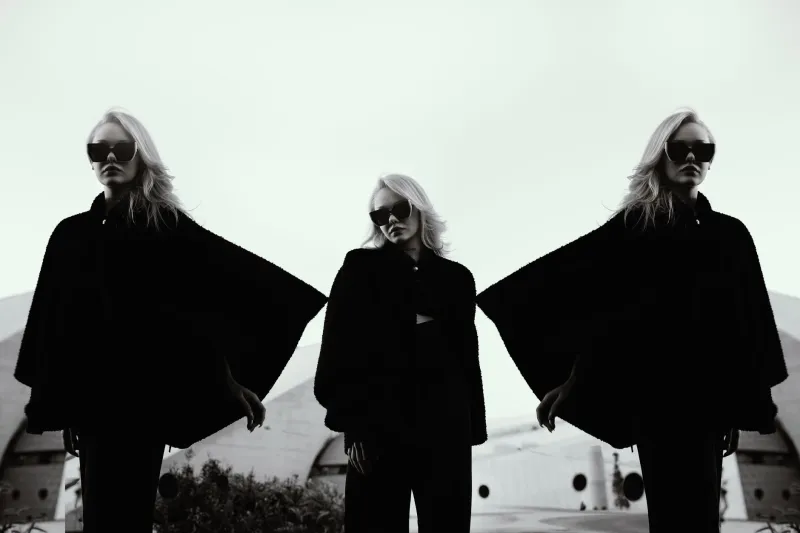
The result is fashion that can look, from the outside, like it's deliberately hostile to conventional attractiveness. Silhouettes that obscure the body rather than reveal it. Proportions that confuse — a coat that dwarfs its wearer, a skirt that hits at the least flattering point. Colors that clash in ways that feel intentional and aggressive. Textures that aren't soft or inviting. Shapes that don't move the way a "woman's body" is supposed to move.
Designers like Comme des Garçons' Rei Kawakubo have been making this argument in fabric for decades. Kawakubo's work has always been about refusing the terms of conventional desirability — her clothes aren't designed to be worn for other people. They're designed to create a private universe for the person inside them. That sensibility, once considered extreme avant-garde, is now filtering into the mainstream in ways that feel genuinely new.
The Designers Building This Language
In the US, designers like Vaquera, Telfar, and Hood By Air have each, in their own way, contributed to a visual vocabulary that prioritizes weirdness, volume, and conceptual provocation over flattery. Vaquera in particular has made a kind of downtown New York absurdism into high art — their shows feel less like runway presentations and more like performance pieces about what clothes can mean when they stop trying to please.
Emerging designers are pushing further. Carly Mark, whose label Puppets and Puppets operates at the intersection of fashion and installation art, makes pieces that feel genuinely uncomfortable to look at — in the best possible way. They're confrontational. They demand something from the viewer rather than offering themselves up.
"I'm not interested in making women look beautiful in the way that's been decided for them," Mark has said in interviews. "I'm interested in making them look powerful, strange, specific."
Powerful, strange, specific. That's a pretty good manifesto.
Why "Unflattering" Is a Power Move
Here's where the politics get interesting. The concept of "flattering" — that long-standing cornerstone of mainstream fashion advice — is almost entirely a function of the male gaze. Flattering means: elongating, slimming, emphasizing certain curves, minimizing others. It means shaping the body toward a particular ideal of femininity.
When women choose silhouettes that don't flatter — that actually obscure, distort, or challenge the body's conventional presentation — they're opting out of that system. They're refusing to make their bodies legible in the expected way.
Stylist and fashion writer Jordan Leake, who writes extensively about gender and fashion from her base in New York, frames it this way: "Choosing an oversized, shapeless garment isn't giving up. It's a refusal to participate in the economy of the female body as spectacle. The woman who wears it isn't invisible — she's just not performing."
Not performing. In a culture that has demanded performance from women's bodies at every turn, that's genuinely radical.
The Street-Level Reality
You don't have to be wearing avant-garde designer pieces to practice this. The ethos shows up everywhere once you know what to look for.
It's the woman on the subway in Chicago wearing a floor-length waxed canvas coat that completely engulfs her frame, paired with chunky boots and an expression that makes clear she is not available for commentary. It's the group of college women in LA who've collectively decided that their aesthetic involves oversized thrifted blazers, wide-leg trousers, and footwear that prioritizes comfort over any conventional idea of sexiness. It's the TikTok creators building followings on deliberately chaotic, anti-trend styling that refuses to resolve into anything easily digestible.
These aren't women who don't care. These are women who have transferred their care entirely away from the external audience and toward their own experience of getting dressed.
What Gets Freed Up
Here's what the women who've made this shift report: it's lighter. Not the clothes — sometimes the clothes are extremely heavy — but the mental load. When you stop dressing for an imagined audience, you stop carrying that audience around with you all day.
You stop checking mirrors for reassurance. You stop doing the mental math of whether your outfit is "too much" for the situation. You stop editing yourself in real time based on who's looking.
What fills that space is something that's harder to name but easier to feel. Call it presence. Call it selfhood. Call it the specific freedom of a woman who has decided that her clothes are a conversation between herself and herself, and the rest of the room is welcome to observe but not to participate.
The Invitation
None of this requires a designer wardrobe or a radical style overhaul. It starts with one question, asked in the dressing room or in front of your closet at 7am: am I putting this on because I love it, or because I think someone else will?
Answer honestly. Then dress accordingly.
The audience will adjust. Or they won't. Either way, you'll be wearing something that's actually yours.